Claude Banned by Trump: Immediate Effects on Anthropic
On March 6, 2026, Bloomberg reported that a senior official from the U.S. Department of Defense (DoD) announced, “The Department of Defense has officially notified Anthropic’s management that the company and its products are deemed a supply chain risk, effective immediately.” This action escalates the ongoing dispute between the DoD and Anthropic regarding AI safety.
Anthropic’s spokesperson did not immediately comment on the situation. The official did not specify how or when the Pentagon notified the company. Anthropic had previously stated that it would challenge the DoD in court if it was designated as a supply chain risk.
Anthropic CEO Dario Amodei had been negotiating with the DoD’s Under Secretary for Research and Engineering, Emil Michael, in hopes of finalizing a contract to regulate how the Pentagon would use Anthropic’s technology.

According to the Wall Street Journal, last Friday, Anthropic received notification that the DoD was prepared to make significant concessions. Previously, the Pentagon had promised not to use Anthropic’s technology for large-scale domestic surveillance or fully autonomous killing machines, but later added qualifiers like “depending on the situation” to leave room for maneuver.
Upon learning that the U.S. government was willing to remove these qualifiers, the Anthropic team felt relieved. However, another challenge arose: they discovered that the Pentagon still wanted to use the company’s AI technology to analyze vast amounts of data collected from the American public. This data could include users’ interactions with common chatbots, Google search histories, GPS location tracks, and even credit card transaction details, all of which would be cross-referenced with other aspects of users’ lives.
Anthropic’s management informed the DoD that this crossed a line, leading to the collapse of the deal. Subsequently, President Trump announced on social media the ban on Anthropic, with Defense Secretary Pete Hegseth also stating that Anthropic posed a supply chain risk—an assessment typically reserved for U.S. adversaries.
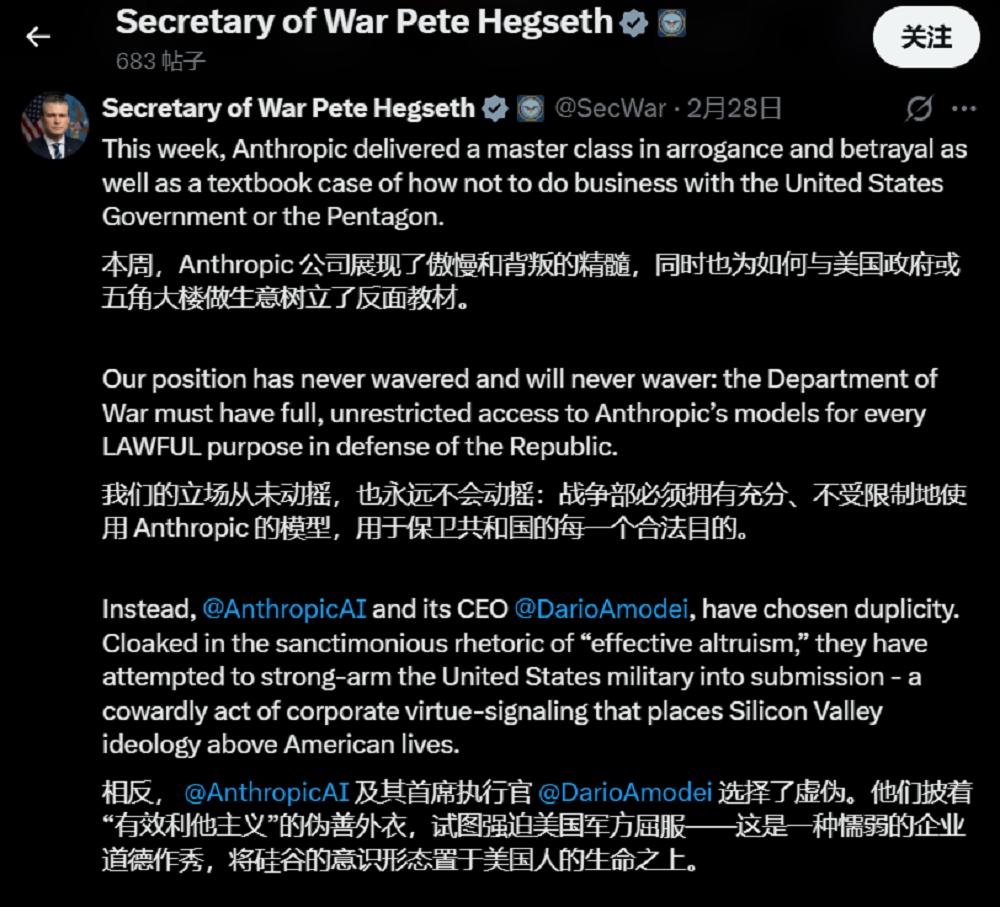
Hegseth ordered U.S. military contractors, suppliers, and partners to cease business relations with Anthropic. The list of companies cooperating with the U.S. military is extensive, including many of the suppliers for Anthropic’s computing infrastructure—such as Amazon.
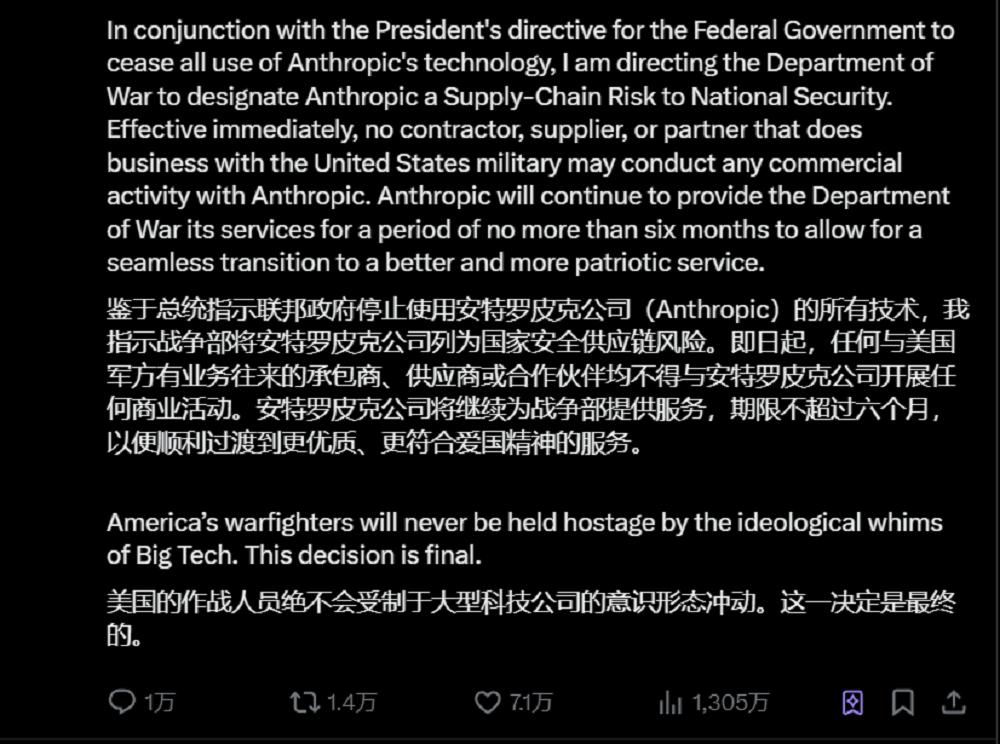
This designation by the Pentagon could have a significant impact on both Anthropic and the DoD. The U.S. government and military contracts have been a vital source of revenue for Anthropic, as well as a means to demonstrate its capabilities and security. In July 2025, the DoD’s Chief Digital and Artificial Intelligence Office (CDAO) signed a contract with Anthropic worth up to $200 million for developing AI agent technology for national security, effective for two years.
At the same time, Anthropic has been providing the Claude enterprise version to various agencies within the U.S. executive, legislative, and judicial branches at a symbolic price of $1 per year, along with technical support, aiming to promote AI technology’s application in the federal government. This could potentially translate into greater revenue opportunities.
Meanwhile, the U.S. military has heavily relied on Anthropic’s models, and until recently, Anthropic was the only AI system provider capable of operating within the Pentagon’s classified cloud environment. Anthropic’s Claude Gov tool has become a preferred choice among many U.S. defense personnel due to its ease of use.
Reports indicate that just hours after the U.S. announced the federal government would stop using Anthropic’s AI tools, Trump used these tools to launch a large-scale airstrike against Iran. On March 1, the Iranian government confirmed that Supreme Leader Khamenei had been attacked, raising speculation about whether AI was involved.
Sources confirmed that command centers worldwide, including the U.S. Central Command, have been using Claude for intelligence assessment, target identification, and simulated combat scenarios.
Lauren Kahn, a senior research analyst at Georgetown University’s Center for Security and Emerging Technology, stated, “This is a great capability, and removing it would be painful for all parties involved.”
Conclusion: Uncertainty Surrounding Anthropic’s Future
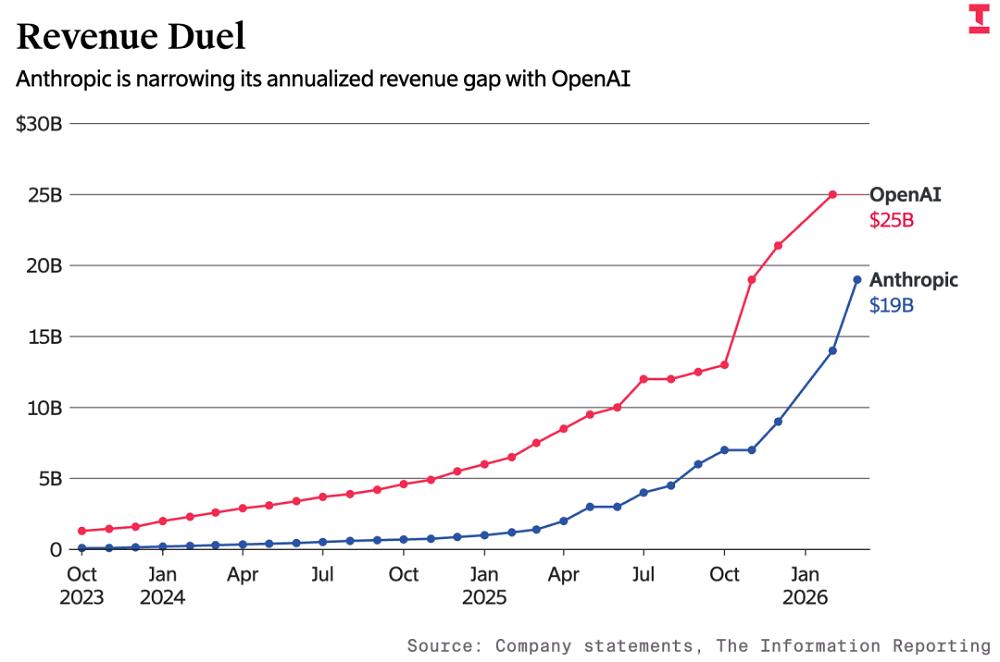
Anthropic’s current valuation is approximately $380 billion, and according to The Information, its recent annualized revenue has surpassed $19 billion, doubling from its revenue at the end of last year, further narrowing the gap with OpenAI.
The dispute with the Pentagon has added uncertainty to Anthropic’s prospects. Corporate clients have always been a core part of the company’s business, with Anthropic selling a significant amount of programming-related technology in this market. Whether being designated as a supply chain risk will have a long-term impact on Anthropic’s sales to corporate clients remains to be seen.
Currently, OpenAI has already signed new cooperation orders with the U.S. military. If Anthropic completely loses its large contracts with the U.S. government and military, and this affects its sales in other areas, the revenue gap between Anthropic and OpenAI may widen.
However, Anthropic is rapidly gaining popularity in the consumer market. Its main application, Claude, recently topped the download charts in the Apple App Store, indicating that public support for the company is growing quickly.
Comments
Discussion is powered by Giscus (GitHub Discussions). Add
repo,repoID,category, andcategoryIDunder[params.comments.giscus]inhugo.tomlusing the values from the Giscus setup tool.