AI Enhances Cultural Tourism
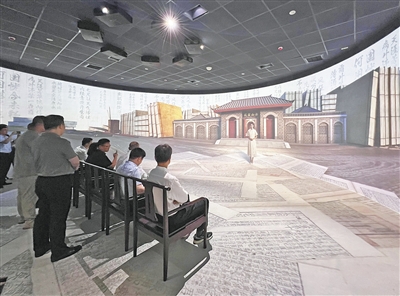
The 14th Five-Year Plan emphasizes the role of digital technology and data in enriching people’s lives and improving welfare across various sectors, including education, healthcare, and cultural tourism.
In Hunan’s Hengyang, the Chuan Shan Academy utilizes AI to create immersive cultural experiences; in Hangzhou, the digital guide “Hang Xiaoyi” serves as a virtual tour guide; and in Dalian, the smart tourism platform “Xing You Dalian” offers personalized itineraries. In recent years, cultural tourism across China has accelerated towards immersive, intelligent, and personalized directions, leveraging artificial intelligence.
Immersive Cultural Experiences
In the spring, a unique “dialogue” is taking place at the Chuan Shan Academy in Hengyang, Hunan: visitors wear AR glasses and see the historical figure Wang Fuzhi, dressed in traditional attire, interpreting the philosophical thoughts from the “Zhou Yi Wai Zhuan”. This immersive scene brings to life the philosophical wisdom from over 300 years ago.
Founded in 1878, the Chuan Shan Academy is a significant origin of Huxiang culture, aiming to promote the thoughts of Wang Fuzhi, a philosopher from the late Ming and early Qing dynasties. Wang advocated for practical application of knowledge, significantly influencing modern Chinese thought.
Previously, the static exhibitions at the academy made it challenging for visitors to fully appreciate Wang’s philosophy. In 2025, the academy launched the AI Digital Human project, utilizing natural language processing and other technologies to present Wang’s likeness and voice. Visitors can engage in conversations with the virtual Wang Fuzhi and trigger AR annotations of his works through gesture interactions, transforming classical texts into dynamic illustrations. “We want visitors to engage in dialogue with ancient thinkers rather than passively receive knowledge,” said Chang Bin, manager of the academy’s planning department.
Visitors can ask questions like, “How does the master view the relationship between knowledge and action?” In the interactive AI lecture hall, the digital human responds with relevant quotes and explanations, creating a two-way dialogue.
“Talking to Master Wang is much more engaging than a history class!” remarked visitor Zhang Yu from Guangzhou. Data shows that in 2025, the academy’s visitor numbers increased by 110.84%, with study groups making up 59.26% of the total, as many parents believe this immersive experience can spark their children’s interest in learning.
“AI does not simply replicate history but constructs an interactive logic based on extensive analysis of Wang’s writings and contemporaneous scholars’ evaluations,” explained the project’s technical team leader. “We filtered out potential biases to ensure the dialogue strictly adheres to the essence of Wang’s teachings.”
At the Chuan Shan Academy, technology and culture blend seamlessly, ensuring the transmission of traditional culture through light and shadow.
Smart Digital Guides
At West Lake in Hangzhou, the spring scenery is beautiful. In front of a cultural tourism consultation kiosk, visitor Yuan Meng uses her phone to tap a blue “smart sticker” on the kiosk, and a charming girl in a qipao named “Hang Xiaoyi” appears on the screen. “Hang Xiaoyi” is Hangzhou’s digital tourism guide, providing real-time city tours and information.
“Is there a crowd at Leifeng Pagoda now?” Yuan Meng asks via voice command, and the guide quickly responds with the current visitor flow at popular West Lake spots. “This is much easier than searching on my phone; it feels like having a free tour guide with me,” she says.
“Can you recommend a route to visit the Broken Bridge?” Yuan Meng inquires. Within five seconds, “Hang Xiaoyi” provides a classic boat tour route: starting from the Hubin Pier, visiting the Broken Bridge, exploring Beishan Street with its historic architecture, and continuing to Baoshi Mountain for a panoramic view of West Lake.
Following the guide, Yuan Meng and her group board a boat, with “Hang Xiaoyi” narrating their journey: “As we paddle on the lake, the waves ripple, revealing a picturesque scene of mountains and cityscape.” “The Broken Bridge in winter, covered in snow, is one of West Lake’s top ten scenic spots,” she adds.
“Hang Xiaoyi” not only introduces attractions but also shares historical and cultural insights along the way. Yuan Meng appreciates the guide’s thoughtful reminders: “Though we won’t stop at places like Liuhe Pagoda or Guangji Bridge, feel free to ask me about routes or stories anytime.”
“By utilizing ‘Hang Xiaoyi’, management and businesses can provide precise services to tourists while also receiving feedback on their preferences, which supports improving service quality and expanding offerings,” said Bo Wengan, deputy director of Hangzhou’s cultural and tourism development center.
Zhou Jiayi, director of the Hangzhou Intangible Cultural Heritage Museum, has experienced this firsthand. Located near the Hangzhou Arts and Crafts Museum, attracting visitors is crucial. “Recently, many tourists told me they found us through ‘Hang Xiaoyi’, which was quite surprising,” she said. “Our museum showcases over 20 unique crafts and intangible heritage techniques, allowing visitors to participate in experiences, making it well worth a visit.”
Now, if visitors ask “Hang Xiaoyi” about intangible cultural heritage sites near the Broken Bridge, she recommends the Handicraft Living Museum based on historical data. “Previously, we introduced AI glasses, and when worn, ‘Hang Xiaoyi’ introduces intangible heritage techniques right before their eyes, increasing visitor engagement,” Zhou Jiayi added.
Professional and Efficient Itinerary Customization
In the spring at Lianjiao Bay in Dalian, the sea is calm and blue, with colorful European-style buildings across the water and seagulls soaring overhead.
“What a great photo!” exclaimed visitor Song Yao, along with her friends. In the picture, they pose with the sea, buildings, and seagulls. “This photo spot and framing were suggested by AI!” Song Yao said excitedly.
The AI she mentioned is part of the local smart tourism platform, “Xing You Dalian”. Utilizing AI models, the app has launched an intelligent route planning feature.
Opening the chat window, Song Yao can see the itinerary generation process for her Dalian trip.
“What attractions are suitable for visiting in Dalian?” she begins her conversation with the app.
The app suggests classic attractions like Dalian Shengya Ocean World and Dalian Forest Zoo. Finding these suggestions too mainstream, she refines her request: “Where are the best photo spots in Dalian?” This time, trendy locations like Fisherman’s Wharf and Nanshan Cultural Street appear in the response.
Continuing her inquiries, she asks, “How can I take great photos at Fisherman’s Wharf?” The app advises, “Capture the entire wharf from a nearby viewing platform to highlight the architectural complexity and harbor. The Lianjiao Bay viewing platform offers a clear view of Fisherman’s Wharf, perfect for photo ops. It’s best to visit on a sunny afternoon; take subway line 5 to Hutan Park station and walk about 20 minutes.”
“It’s like having a thoughtful ’travel butler’ that eliminates the need to switch between different apps for travel, accommodation, and dining. I just need to describe my needs accurately, and it provides a comprehensive guide. For topics I’m particularly interested in, I can ask further questions,” Song Yao explained.
After a short conversation with the app, Song Yao finalized her desired locations and requested, “Design a two-day itinerary for Dalian, including Lianjiao Bay, Dongguan Street Historical and Cultural District, experience riding the tram, and encountering sika deer along the coastal road, with Lianjiao Bay scheduled for the afternoon.”
Seconds later, a detailed personalized itinerary appears in the chat: Day one covers the coastal route, visiting the ocean world, Lianjiao Bay, and seeing sika deer, while day two explores the city’s street scenes. “I’m very satisfied with this itinerary, as it allows me to experience Dalian’s maritime culture and the city’s historical charm,” Song Yao said.
“By integrating AI models, the ‘Xing You Dalian’ app has upgraded to an intelligent ’travel butler’, enhancing planning efficiency and visitor experience,” said Shan Meina, director of Dalian’s cultural and tourism bureau. The app has accumulated nearly 430,000 users.
Comments
Discussion is powered by Giscus (GitHub Discussions). Add
repo,repoID,category, andcategoryIDunder[params.comments.giscus]inhugo.tomlusing the values from the Giscus setup tool.