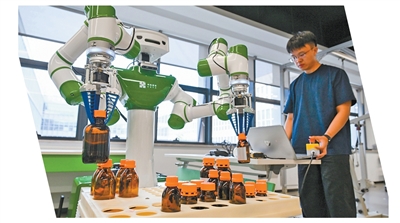
 At the Intelligent Manufacturing Research Institute of Hefei University of Technology, staff are debugging an AI chemical management robot.
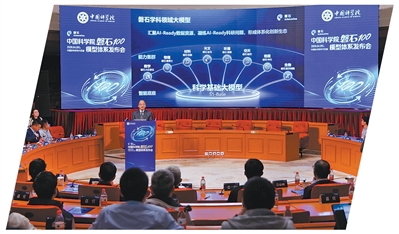 The Chinese Academy of Sciences has released the “Rock 100” model system, which aims to create a cluster of large models across eight disciplines.
 Currently, AI is increasingly involved in scientific research, from predicting protein structures to discovering new materials, showcasing its potential as a “universal engine” for scientific acceleration.
How is the Path of Scientific Discovery Changing?
Traditional research starts with “hypothesis-verification,” but now it is gradually shifting to a new paradigm of “data-pattern discovery-intelligent generation-closed-loop iteration.”
Wang Xijun, a distinguished professor at the University of Science and Technology of China, explains that in traditional research, scientists often propose questions based on experience and intuition. Now, for some disciplines, AI can actively discover patterns in massive datasets, transforming the path of scientific discovery. AI can even design desired substances precisely according to target requirements.
For instance, in the field of framework materials, combinations of different metal nodes, organic ligands, and connection methods can produce an enormous number of structures, potentially reaching trillions, far exceeding human exploration limits. In this context, AI provides breakthroughs. On one hand, machine learning can quickly predict material performance, saving significant trial-and-error costs. On the other hand, AI can extract patterns from data, transforming past intuitive approaches into computable, transferable models, making material design more rational.
On this basis, generative AI can further push research from “screening knowns” to “creating unknowns”—directly generating entirely new material structures beyond training data, achieving “reverse design” around target performance. This means AI is not only accelerating problem-solving but also expanding the boundaries of the problems themselves.
Thus, AI’s role in research continues to evolve: from an initial computational tool to a research tool that assists in analyzing patterns, and now to a “research partner” that can participate in and even drive autonomous exploration.
Of course, AI will not replace scientists. Understanding key scientific issues and mechanisms still relies on human judgment and insight. Humans are responsible for posing questions and guiding direction, while AI seeks possible answers within vast data and complex spaces. The collaboration between the two will provide a more robust and expansive space for future scientific innovation.
Has Research Innovation Efficiency Improved?
AI is particularly adept at handling tasks with clear answers that require extensive repetitive calculations.
Mo Bofeng, a professor at the Capital Normal University, states that AI has significantly improved research efficiency in literature review, experimental design, and data analysis. Even with oracle bone inscriptions from over 3,000 years ago, AI can play a significant role. Previously, tasks like oracle bone splicing and restoration relied on the experience of a few experts. Now, AI offers new solutions.
To truly harness AI’s capabilities, it is crucial to identify the right intersection. As oracle bones are archaeological documents, the core research goal is to restore textual materials and information, and AI excels at handling tasks with clear answers and repetitive calculations. It can identify subtle features that are difficult for humans to detect, such as the curvature of fractures and the angles of strokes in characters, providing key clues for splicing and restoration.
However, AI is not omnipotent. The total number of oracle bones exceeds 160,000, with over a million characters. While this seems substantial, it is still insufficient for training large AI models. Therefore, human experts are still needed for deep semantic judgments. A more effective approach is human-machine collaboration: using AI as a speed-enhancing tool while relying on expert judgment to review and correct its results.
Currently, splicing and restoration are just the beginning of AI-assisted oracle bone research. As technology advances, classification, aggregation, and translation of oracle bones will gradually break through. Future researchers will need not only professional knowledge but also enhanced data processing capabilities, adept at leveraging technology to amplify their research advantages.
Will AI Influence Research Judgment?
While lowering some research barriers, risks such as false citations and erroneous reasoning deserve attention.
Yang Yaodong, a researcher at Peking University’s Institute of Artificial Intelligence, notes that AI is not just assisting researchers in coding, literature review, and chart creation; it is changing the entire research process: from a linear flow of hypothesis formulation, experimentation, and result analysis to a closed-loop system characterized by human-machine collaboration, model prediction, automated experiments, and feedback iteration.
This change brings several benefits. First, efficiency is significantly enhanced, especially in fields like materials, pharmaceuticals, and energy, where there are numerous candidate solutions that traditional methods struggle to exhaust. AI can quickly screen options, liberating researchers from repetitive trial and error to focus on key issues. Second, it promotes interdisciplinary integration, as a scientific problem often involves physics, chemistry, biology, engineering, and computation, with AI establishing connections between multi-source data. Third, it lowers some research barriers; with open-source models and tool platforms, small teams can undertake large projects.
However, it is essential to recognize that AI does not equate to genuine scientific understanding. Scientific research must not only be accurate in predictions but also answer the “why.” If models are black boxes, data sources unclear, and experimental processes non-reproducible, the conclusions drawn by AI could introduce new risks. Particularly, generative AI may lead to false citations, erroneous reasoning, low-quality papers, data leaks, and unclear academic responsibilities, all of which could impact research norms.
A deeper issue is that research judgment cannot be replaced by tool logic. AI excels at finding optimal solutions within existing data, but determining which questions are worth investigating and which results hold scientific significance still requires human oversight.
How to Achieve Effective Resource Integration?
Connecting scientists, AI engineers, and industrial forces to shift innovation from isolated breakthroughs to systematic acceleration.
Wu Libo, assistant to the president of Fudan University and chairman of the Shanghai Institute of Science Intelligence, states that scientific intelligence is transitioning from a “technology-centered” 1.0 era to a “scientist-centered” 2.0 era. The 2.0 era aims to make more scientists the protagonists, allowing AI to truly permeate the entire research process. The Shanghai Institute of Science Intelligence and Fudan University jointly created the Xinghe Qizhi Open Platform for Scientific Intelligence to respond to this shift.
The platform’s primary role is to lower the barriers for scientists to use AI. It builds a comprehensive infrastructure covering data, models, computing power, experiments, intelligent agents, and collaborative communities around real research paths. Currently, the Xinghe Qizhi Open Platform has gathered over 400 scientific models and tools, 22PB of high-value data, and 500 million literature patents, allowing scientists to conduct research without delving into technical details.
We also launched a research intelligent agent system based on “Dasheng”. It can understand scientific questions and assist in completing the entire process from literature analysis, hypothesis generation to experimental validation. Recently, “Dasheng” introduced a custom laboratory feature, enabling scientists to build exclusive toolchains based on their research directions.
The second role of the platform is to promote interdisciplinary, interregional, and inter-field integration. In traditional research, data, models, and methods from different disciplines often do not communicate, making collaboration difficult. The Xinghe Qizhi Open Platform facilitates sharing, reuse, and combination of results across different fields through a unified model repository and data infrastructure.
On a deeper level, the platform acts as a hub for the scientific intelligence ecosystem. It connects scientists, AI engineers, and industrial forces, allowing data and methods to flow and be reused within the system, shifting innovation from isolated breakthroughs to systematic acceleration, providing sustainable institutional support for AI-driven research paradigm transformation.
How to Build and Utilize Intelligent Platforms Effectively?
Encouraging open sharing to bridge the gap between industry and research.
Liu Tieyan, president of Beijing Zhongguancun College and chairman of the Zhongguancun Artificial Intelligence Research Institute, emphasizes that having many platforms does not equate to them being usable, effective, or truly useful. Last year, Zhongguancun College surveyed over 30 materials companies in Beijing and identified 100 “bottleneck” issues. The survey revealed that with current mainstream scientific intelligence technologies, only 20% of these problems are likely to be solved. The rest remain unsolvable due to low levels of digitalization in enterprises, data deficiencies, and insufficient algorithm accuracy. This realization highlights that “AI empowering research” cannot just be a slogan; issues like infrastructure deficits, technological limitations, and the industry-research gap are real.
Furthermore, the open sharing of scientific intelligent agents and tools appears to be a technical issue on the surface, but at a deeper level, it is a lack of motivation to bridge the gap. Why would an organization want to open its data and platform? Without institutional answers to this question, “open sharing” will remain at the level of advocacy.
To break the deadlock, it is suggested to focus on three areas: first, vigorously promote industrial digitalization to guide scientific research directions with genuine industrial needs. Research should not remain in a “research first, then transform” model; industry feedback should enter the research cycle to fill the “last mile”. Second, establish incentive mechanisms for open sharing, making sharing a recognized research contribution, such as being a condition for project initiation and conclusion, and creating a citation metric system similar to that of papers. Third, public entities should take the lead in building foundational infrastructure for interdisciplinary collaboration. Users of scientific intelligent agents and tools are highly specialized and dispersed across various disciplines. Due to insufficient market size, national strategic investment could be considered first, gradually introducing market mechanisms.
In summary, bridging data and intelligent agent interfaces is the surface issue; restructuring incentive mechanisms is the middle layer; and fundamentally, research must face national needs and genuine industrial problems.
Comments
Discussion is powered by Giscus (GitHub Discussions). Add
repo,repoID,category, andcategoryIDunder[params.comments.giscus]inhugo.tomlusing the values from the Giscus setup tool.